Something that can back up "good for the environment."
"We've adopted sustainable products." Until now, saying that was enough. From here on, you'll be asked for the evidence. Since 27 September 2026, the EU has banned environmental claims that cannot be substantiated (EmpCo Directive). In Japan, sustainability disclosure in annual securities reports is being phased in under the SSBJ standards from the fiscal year ending March 2027, starting with the largest Prime Market companies — including emissions from the products a company buys (Scope 3). Uniforms are part of that.
KEIF builds products so that the evidence is there. We design without blending fibers, and we don't stop at making. We issue a DPP for every style, color and size, disclosing where, by whom and how each product was made — so that you can explain why it is sustainable with records, not words.
Defined by three pillars: materials, systems and disclosure.
KEIF's design starts with the wearer: ease of movement, your company's strategy, the experience after rollout, and the environment. Of the four layers of our design (WISE), this page covers Earth — the environment. We treat the environment not as the starting point, but as the destination.
SelectMaterials
We choose materials for both what the wearer needs and how easily they can be recovered afterwards. Main fabrics are single-material by default.
SelectMaterials
We choose materials for both what the wearer needs and how easily they can be recovered afterwards. Main fabrics are single-material by default.
MakeMaterials
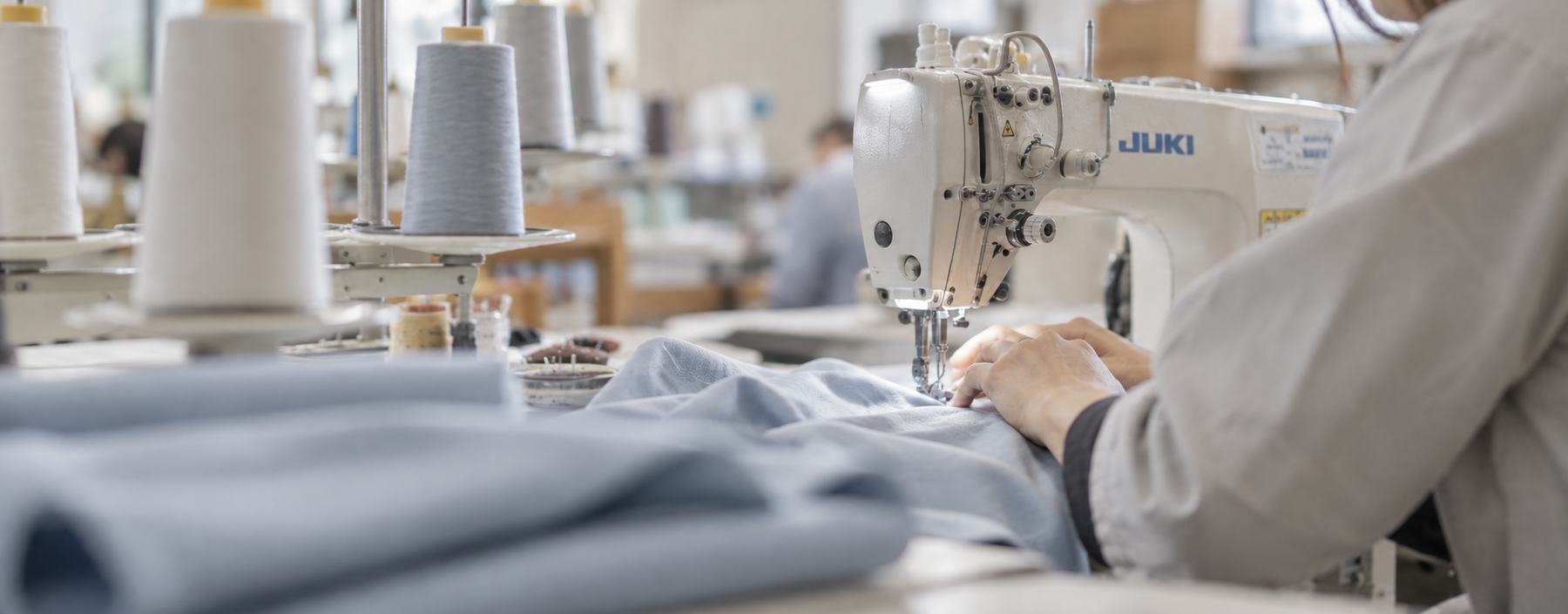
Fabric in Taiwan, sewing at partner factories, finishing in Japan.
Wear
On your sites.
RepairSystems
If it tears, contact KEIF. Our partner factory in Fukuoka will repair it (charged; quoted in advance).
Take backSystemsIn preparation
When garments reach the end of their life, KEIF takes them back.
RecoverSystemsIn trial
We return them to resources: reuse as-is for another purpose, turn them back into fiber and spin new yarn, or break them down to raw material. The best route depends on the material, the volume and the distance, so we are comparing them now.
Record (DPP)Disclosure
For every style, color and size.
1 / 7
SelectMaterials
We choose materials for both what the wearer needs and how easily they can be recovered afterwards. Main fabrics are single-material by default.
MakeMaterials
Fabric in Taiwan, sewing at partner factories, finishing in Japan.
Wear
On your sites.
RepairSystems
If it tears, contact KEIF. Our partner factory in Fukuoka will repair it (charged; quoted in advance).
Take backSystemsIn preparation
When garments reach the end of their life, KEIF takes them back.
RecoverSystemsIn trial
We return them to resources: reuse as-is for another purpose, turn them back into fiber and spin new yarn, or break them down to raw material. The best route depends on the material, the volume and the distance, so we are comparing them now.
Record (DPP)Disclosure
For every style, color and size.
If any one part is missing, the loop doesn't close. The right material is wasted without a way to take it back. A take-back system proves nothing without records.
We record them on a blockchain (chaintope's Tapyrus), so it can be checked later that nothing has been changed. Environmental impact (CO₂) will be shown as an estimate at launch, then replaced with figures based on measured data after the LCA for our first product. The records are built to support explanations to business partners and formal disclosures.
We don't stop at making.
Repair when it tears, take it back when it's done, return it to resources. We decide that flow before we make anything.
Repair it and keep wearing it. Send it back when you're done.
Repair
If a garment tears or frays, send it to KEIF and our partner factory will repair it. Skilled technicians handle every repair. We'll confirm the cost and turnaround once we've seen the damage. Request a repair through our contact form.
We will start taking back used KEIF products when our first line launches in 2027. The main fabric is a single material, so it is designed to be easier to recover without separating fibers. We are still trialling the recycling process, and we'll publish the take-back steps here before the service starts.
Design
Circularity can't be added later.
Whether a used garment can go back into resources is decided not when it is collected, but when it is made.
Blended
At end of life
Can't be separated
Not blended
At end of life
No separating needed; choose how to recover it
Most garments blend fibers to get performance. KEIF looks for ways to get performance without blending.
For example, the usual way to hide sweat marks is to blend in a different fiber; KEIF uses heather yarns of the same fiber in different shades. And instead of blending in polyurethane for stretch, we aim to get it from the weave structure.
For the wearer
The usual way
The way KEIF aims for
Less visible sweat marks
Blend in a different fiber
Heather yarns of the same fiber in different shades
Ease of movement
Blend in polyurethane for stretch
Get stretch from the weave structure
All of this is so the fibers don't need separating at end of life. In each case, this is the approach we are designing toward. Material composition is decided per product and published in its DPP.
Who we work withFabric: our textile partner in TaiwanRecords: chaintope's TapyrusFinishing, inspection and repair: our partner factory in Fukuoka
Articles — what our Articles of Incorporation say
Written into our company rules from day one.
So that this commitment can't be quietly changed later, KEIF wrote it into its Articles of Incorporation when the company was founded in July 2026. This is not an existing business that changed course midway. Changing it requires a special resolution of the shareholders' meeting.
English translation for reference. The Japanese original prevails.
Article 3 — Purpose
Leaving a system of honest making for future generations.
The Company's core public-interest purpose is to leave for future generations an honest record of manufacturing processes in the apparel industry, to ensure supply-chain transparency, and to contribute to the realization of a circular economy.(Article 3, Paragraph 2)
Article 24 — Directors' decisions
Deciding with people and the environment in mind.
In performing their duties, directors shall consider not only the interests of the Company and its shareholders, but also the impact of the Company's business activities on the following stakeholders and matters:(Article 24, Paragraph 1, excerpt)
Workers and their families (throughout the supply chain)
Business partners and clients
Local communities
The natural environment (including the impact on future generations)
The Company's short- and long-term interests, and the purpose set out in Article 3
It also states that a decision made with honest consideration for people and the environment shall not be deemed a breach of duty merely because it did not prioritize shareholder interests alone (Article 24, Paragraph 3).
In Progress
What we are preparing now
We will update this page as soon as we can provide the evidence.
Recycled-content ratios will be published once we have measured values.
Third-party verification will follow once the EU sets its requirements for textiles (expected in 2027).
We are running trials on recycling recovered materials.
Take-back of used products will start with our 2027 launch.
Unless we can back it up, we won't use expressions like "eco-friendly."
Contact
The evidence, for every style, color and size.
You will be able to check everything on this page in the Digital Product Passport (DPP) for each style, color and size.