KEIF / Digital Product Passport
Digital Product Passports, for uniforms.
Scan the QR code on a garment and it opens: which yarn it was made from, and where it was woven, sewn and shipped. Every uniform KEIF delivers carries this record.
Why
A record that answers with evidence.
Uniforms fall under Scope 3 Category 1 (purchased goods and services). Yet so far, few suppliers can provide primary data for them.
A customer asked for the CO₂ emissions and origin of your uniforms. You asked your supplier and got no answer.
Uniforms belong in your purchased goods and services. Without primary data, all you can do is estimate with emission factors.
You'd like to cover it in your integrated report or recruitment materials, but have no evidence to cite beyond "eco-friendly material".
How
Recorded at every step, opened with a QR code.
- 01Collected at each process
At fabric, sewing and finishing, we collect materials, who did the work and how it was shipped.
- 02For every style, color and size
Each color-and-size combination gets its own DPP.
- 03Written to Tapyrus
So it can be checked later that nothing has been changed.
- 04Opened with a QR code
Just scan it with a phone. No app needed.
We don't issue one page per product model. Fabric weight and shipping differ by color and size, so we issue a DPP for each combination — and it can be used as a calculation basis. Records are kept on Tapyrus, a public blockchain developed by chaintope in Fukuoka.
Live
Not an explanation — the actual screen.
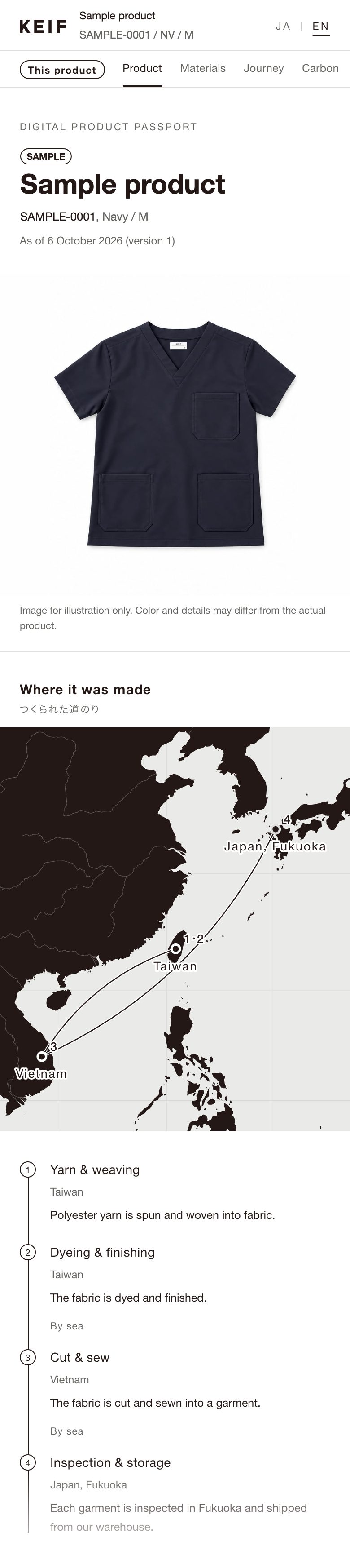
The rest is on each product's DPP, via its QR code: the CO₂ estimate, care, and the proof and record.
We explain DPPs by showing the actual screen. This is what a KEIF DPP looks like. Scroll inside the screen to explore.
The content is provisional. Issued DPPs will be available from January 2027, when our first product — medical wear — launches. Until then, treat this as a sample of the fields and layout.
Sample screen. The content shown is provisional.
Contents
What a DPP contains
Public
What we display now
For business partners
What we provide to business partners
Roadmap — added step by step
We publish what we can stand behind, as soon as we can.
What you see in the demo above is everything we can show today. Some items are not there yet, and we'd rather tell you what is missing up front.
We will show CO₂ from raw materials to arrival at our warehouse in Japan (for now, up to shipment from the factory), calculated from factory records and public data. It will be published as a self-declared estimate before sales begin, and recalculated in 2027 using data from actual production lots. Third-party verification will follow once the EU sets its requirements for textiles (expected in 2027). Business buyers can use the figure for Scope 3 Category 1, labelled as an estimate.
DPPs are being set up under the ESPR, but what textile products must carry, and in what format, has not been finalized. Building to an unsettled spec means rebuilding when it is fixed. We publish what we can state with certainty now, and will add to it once the requirements are set.
The SSBJ standards were published in March 2025, and the timeline for applying them has been set. There is no set format for data that suppliers provide, so we are shaping ours to fit what the standards ask for.
Background
Why records matter now
| Regulation | What it requires | Timing |
|---|---|---|
| ESPR (EU) | Digital product information, product by product. Textiles are a priority category. | Phased in |
| EmpCo Directive (EU) | Bans environmental claims that cannot be substantiated. | Since 27 September 2026 |
| SSBJ (Japan) | Scope 3 disclosure. Uniforms fall under Category 1. | From the fiscal year ending March 2027, phased in |
| Circular economy | Knowing exactly what a material is comes before taking it back and recycling it. | KEIF's purpose since founding |
See the regulations in detail+
The EU is moving to require digital product information in stages, with textiles among the priority categories. For companies selling workwear and similar products into the EU, it will become unavoidable (medical devices and personal protective equipment are excluded). Scope and timing need ongoing monitoring.
Phased inAn EU directive that has applied since 27 September 2026 through the national laws of member states. It bans vague environmental claims that cannot be substantiated, and unreliable sustainability labels. Writing "eco-friendly material" is no longer enough; you need to be able to back it up.
Since 27 September 2026In Japan, sustainability disclosure in annual securities reports is being phased in from the fiscal year ending March 2027, starting with the largest Prime Market companies. Supply-chain emissions (Scope 3) are included, with a transitional relief from Scope 3 disclosure in the first year of application. Uniforms fall under Category 1 (purchased goods and services). Companies must also disclose how much primary data they used to measure Scope 3, so those that disclose will in turn ask their suppliers for primary data. We track the standards and how they are applied, and reflect them in how we keep records. Check when your company is in scope.
Phased in from the fiscal year ending March 2027Without records, there is no way to know how a returned garment can be recycled. Being able to identify the material is a precondition for circularity. Contributing to a circular economy has been KEIF's purpose since it was founded.
KEIF's purpose since foundingFAQ
Frequently asked questions
What is a Digital Product Passport?+
A digital record that travels with a product: where it was made, from what materials and through which processes. The EU is introducing DPPs under the ESPR, with textiles among the priority categories.
What does a DPP on our uniforms let us do?+
When a business partner asks about origin, materials or processes, you can open the record and show them on the spot. CO₂ emissions will be shown as an estimate at launch, then replaced with figures based on measured data after the LCA for our first product. What we show today is a sample, and its content is provisional. We will also provide the primary data for Scope 3 Category 1 calculations, together with the calculation basis.
Do ready-made products come with a DPP?+
Yes. Whether you order ready-made, made-to-order or branding work, every product we deliver carries a DPP.
How can I check that the records have not been changed?+
We record them on the Tapyrus blockchain, so it can be checked later that nothing has been changed. The steps for checking are included in the documents we provide.
Can you issue DPPs for uniforms made by other companies?+
No. We can only issue DPPs for products KEIF manufactures, because the records can only be collected from inside the production process.
Contact
In a form you can use for disclosure
Your first consultation is free. Share the questionnaire or calculation sheet you're working with, and we'll check on the spot whether we can supply data in that format.