KEIF / Services
Uniforms — made, presented, managed.
Three services. Use one, or all three. Every product KEIF delivers comes with a Digital Product Passport (DPP).
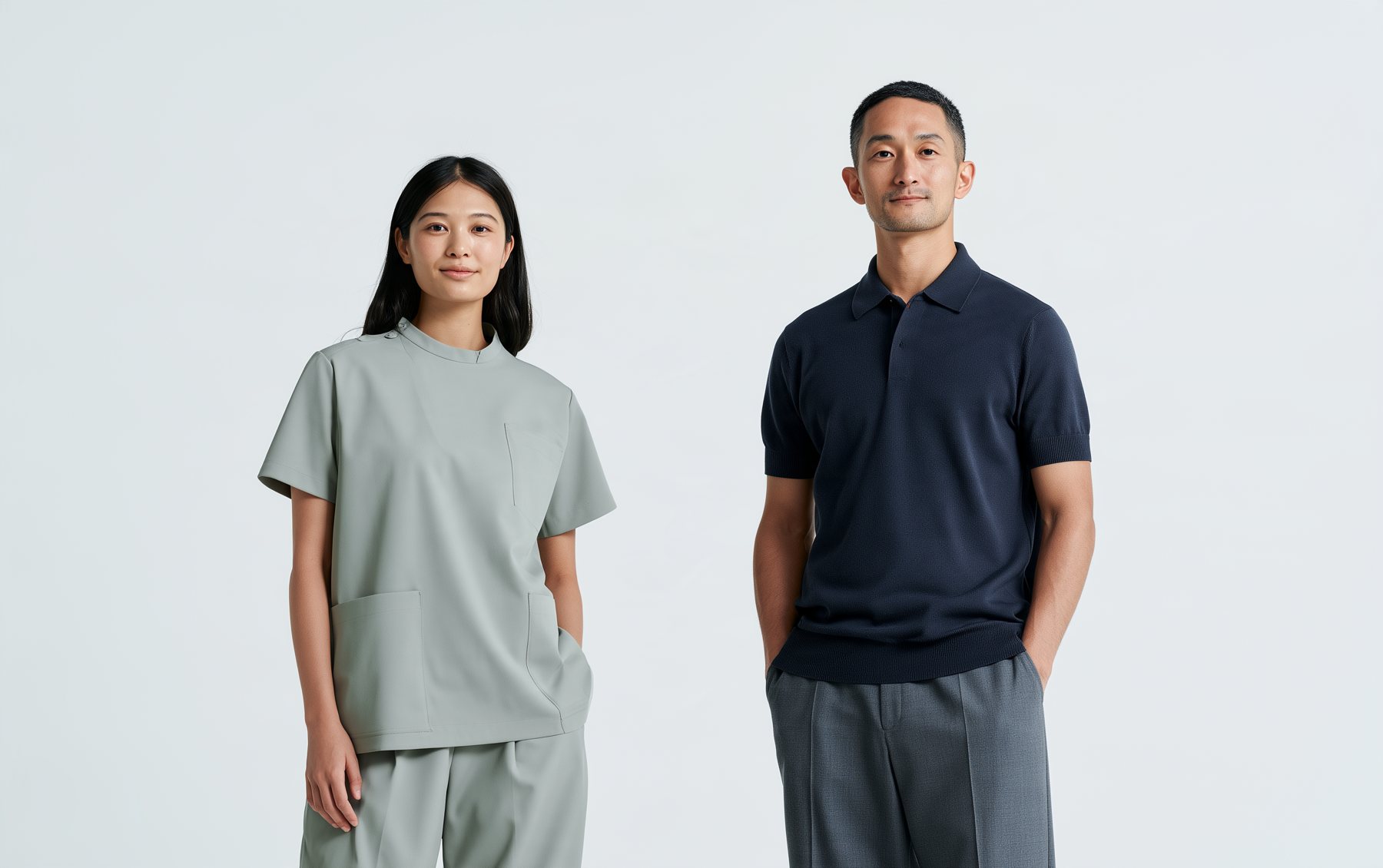
Ready-made and made to order, from healthcare to workwear. Materials are chosen for performance and ease of recovery, to suit each use.
02Branding↓We don't stop at making — we design how the uniform is presented and run. As a fixed-term project or an annual retainer.
03Portal↓Quotes, orders, deliveries and exchanges on one screen. Free for existing clients.
Concept — WISE
KEIF's design is built on four layers.
Being right for the person wearing it is a given. Where KEIF starts thinking is the question beneath it: what is this for?
We don't stop at the moment it's worn. Distributing, restocking, repairing and returning are all part of the design. And beyond people, we commit to the environment.
These four layers together make KEIF's design. We call them WISE, after their initials.
Easy to move in, tough in the wash, and pleasant to wear.
We design from your management challenges, from hiring to team cohesion.
Choosing, distributing, repairing, returning. We design the effort out of each step.
Single-material fabrics by default, with manufacturing records kept in a DPP.
Our services are divided into three to design these four layers.
Uniform
Choose, or create. Two options.
We learn about your roles and tasks, then propose the materials and design that fit — down to ease of movement, fatigue and how motivated people feel wearing it. Fabrics are selected from existing ranges to suit the function and use.
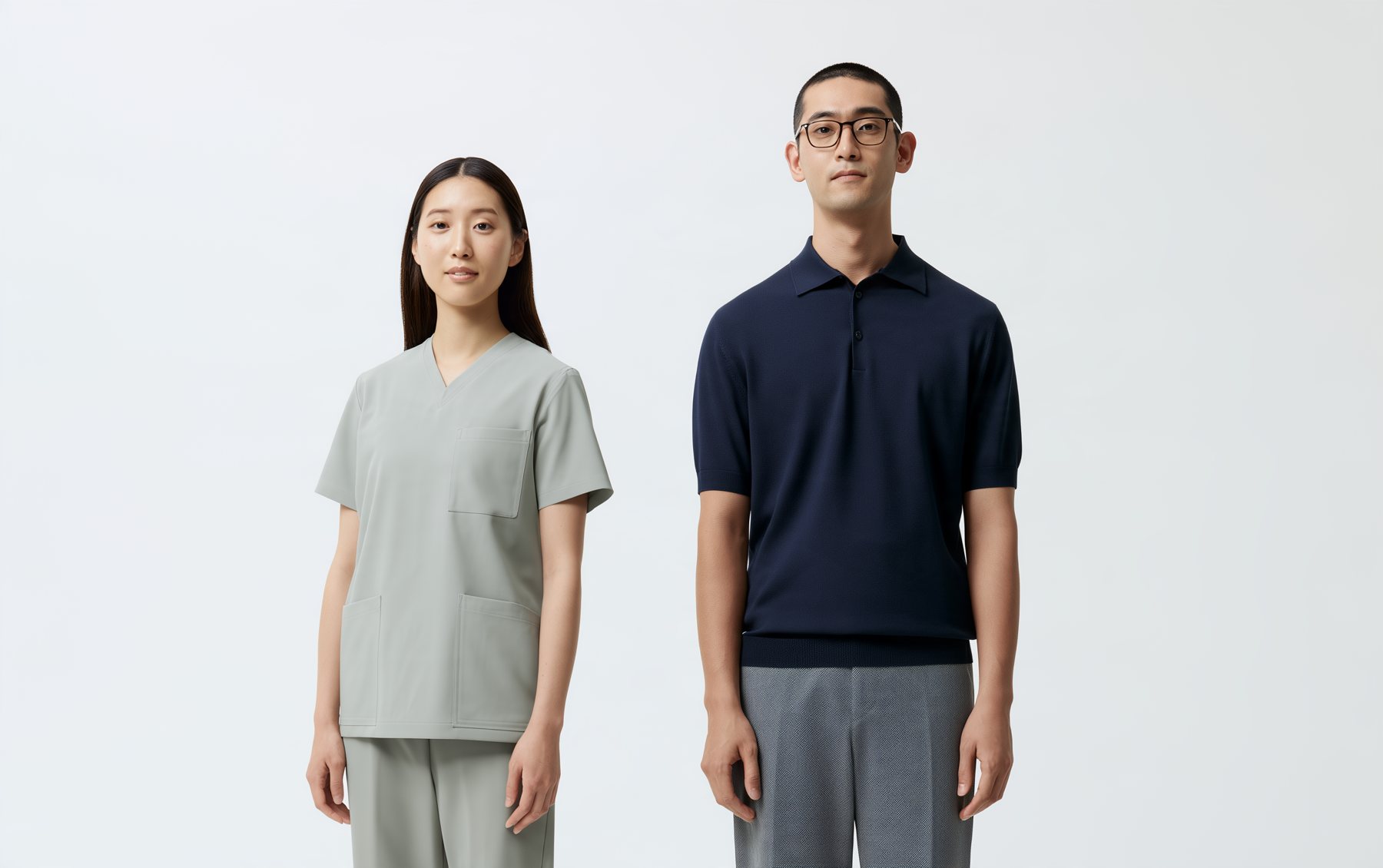 ChooseReady-madeReady-made
We are preparing ready-made products designed and made by KEIF. Our first product is planned for January 2027.
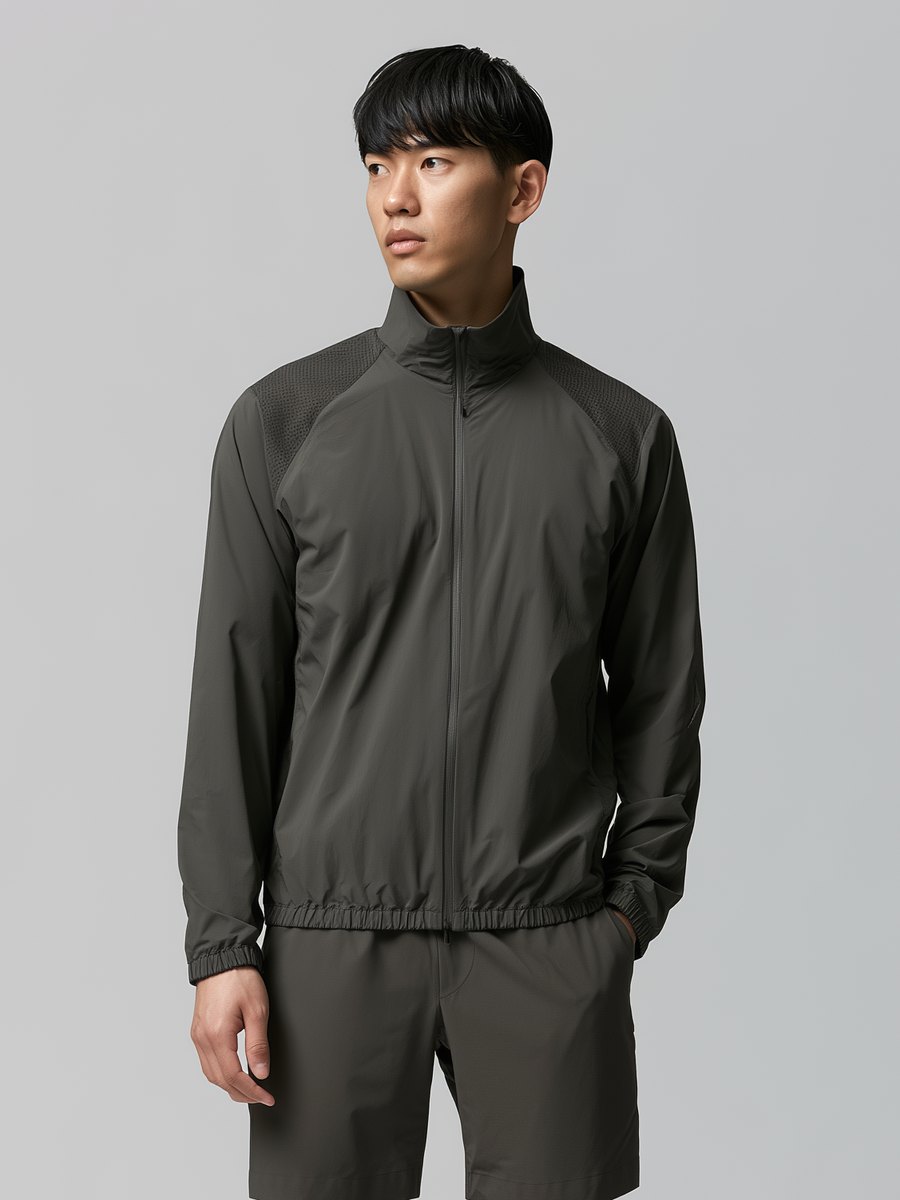 CreateMade to OrderMade to Order→
We learn about your roles and sites, and design for your company.
How ready-made and made to order compare
Guide figures for quantities, lead times and prices. We can give you estimates before anything is fixed.
| Ready-made | Made to Order | |
|---|---|---|
| Design freedom | Choose color and size | Pattern, color, trims and embroidery designed for your roles and sites. Fabric is selected from existing ranges. |
| Lead time | 2–3 weeksShipped from stock | 6 months+From interviews through sewing and shipping |
| Minimum order | 1 piece | 500 pieces |
| Guide price | Coming soon | from JPY 10,000per piece |
| Best for | Trying it first, while headcount is still unclear | A uniform that is distinctly yours, fitted to your roles and sites |
* Minimum order, lead time and price are guides only.
* Prices are per piece and vary with quantity, design and finishing. Excludes shipping and consumption tax.
* Made-to-order lead time runs from the first interview to delivery.
* These terms apply to delivery within Japan. For delivery outside Japan, please contact us.
Lead time by plan
See the made-to-order stagesMatches the numbers on the bar above
| Stage | Typical time | What happens |
|---|---|---|
| 01Interviews and proposal | approx. 1 month | We learn about your work and sites, then propose fabric, specifications and a quote. |
| 02Specification | approx. 1 month | Pattern, color and trims are decided; patterns are made. |
| 03Fabric | a few weeks | Selected from existing fabrics to suit function and use. |
| 04Samples | 1–2 months | Sewn and checked in the real thing. We allow for two rounds. |
| 05Production | approx. 1 month | Full production begins. |
| 06Shipping and delivery | approx. 1 month | Shipping, inspection and sorting by location. |
* All times are guides and vary with quantity, specification and fabric stock. For ready-made, the time runs from shipping from stock to arrival.

Design
One Form. One Company.
One form brings a company together.
Made to Order — outside in, inside out
Designed from how clients see you, and how your people feel.
Bending, carrying, walking the floor — every role moves differently. Matching those movements is a given. On top of that, we think from two points of view.
From the outside: how does the company look to the patient in the consulting room, the client handing over a delivery, the customer in the shop? From the inside: how does it feel, for the person wearing it, to work for that company?
A quiet consulting room, a warehouse at dawn, a workshop in the morning, a van on city streets. The same standing job calls for different colors and materials when the scene is different. When we make a proposal, we bring pictures like these. Tap a photo to enlarge it.
Other fields
We also take on care and welfare, offices and reception, manufacturing plants, food factories, construction sites and more. The same "standing job" means different things. Near machinery, we tighten the cuffs and keep buttons off the outside. Where foreign-matter contamination is a risk, we remove outer pockets. On sites that pass 35°C in summer, we start from vent placement and colors that hide sweat. Even under the same job title, what we decide depends on the movements of the day.
Branding
From the uniform to your company's brand.
Branding starts with the uniform. How people work, and how they look from outside — the picture of the company that emerges while designing the uniform is translated into color, form and logo placement, right down to issuing rules and how it is worn. From there, it goes beyond uniforms: logo and mark design, internal booklets, recruitment photography, even websites and business systems. You can build out your company's brand step by step. There are two ways to contract.
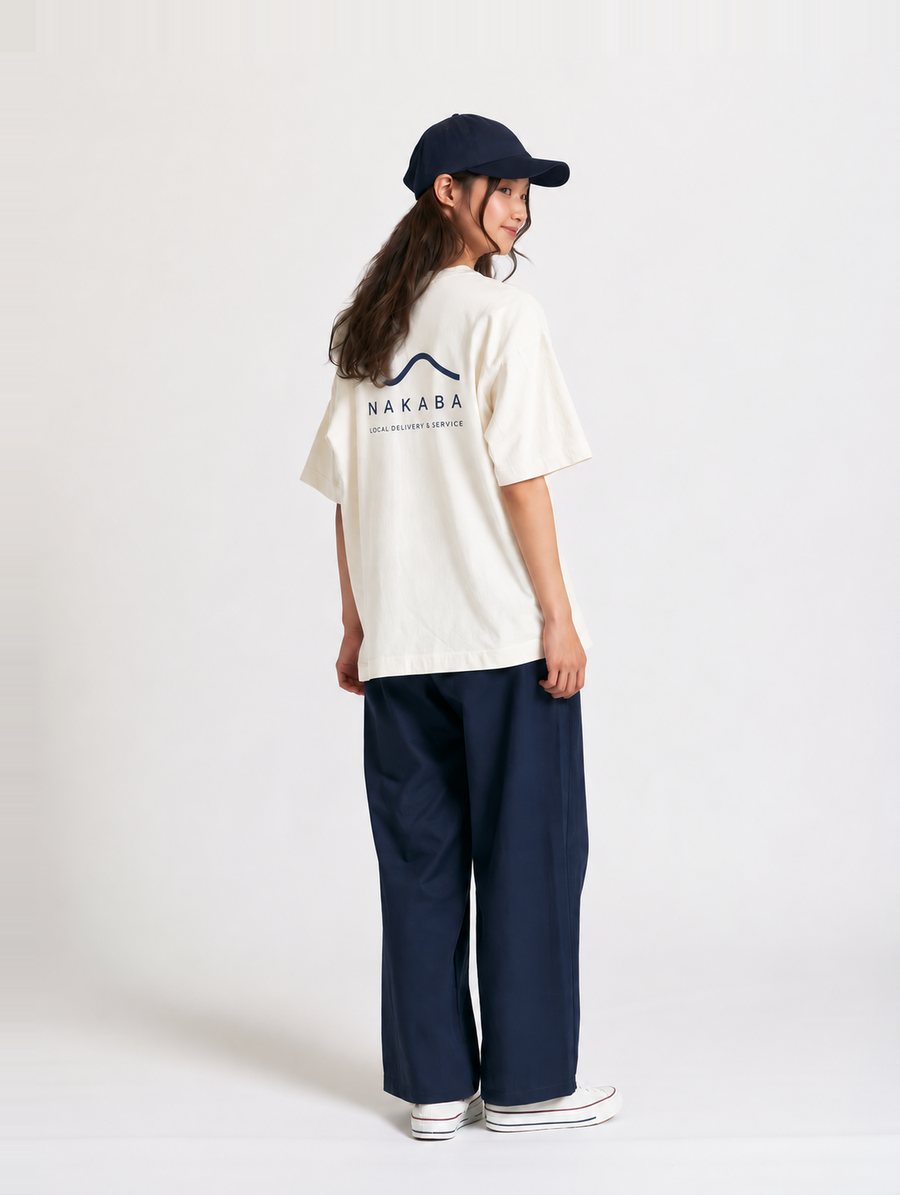
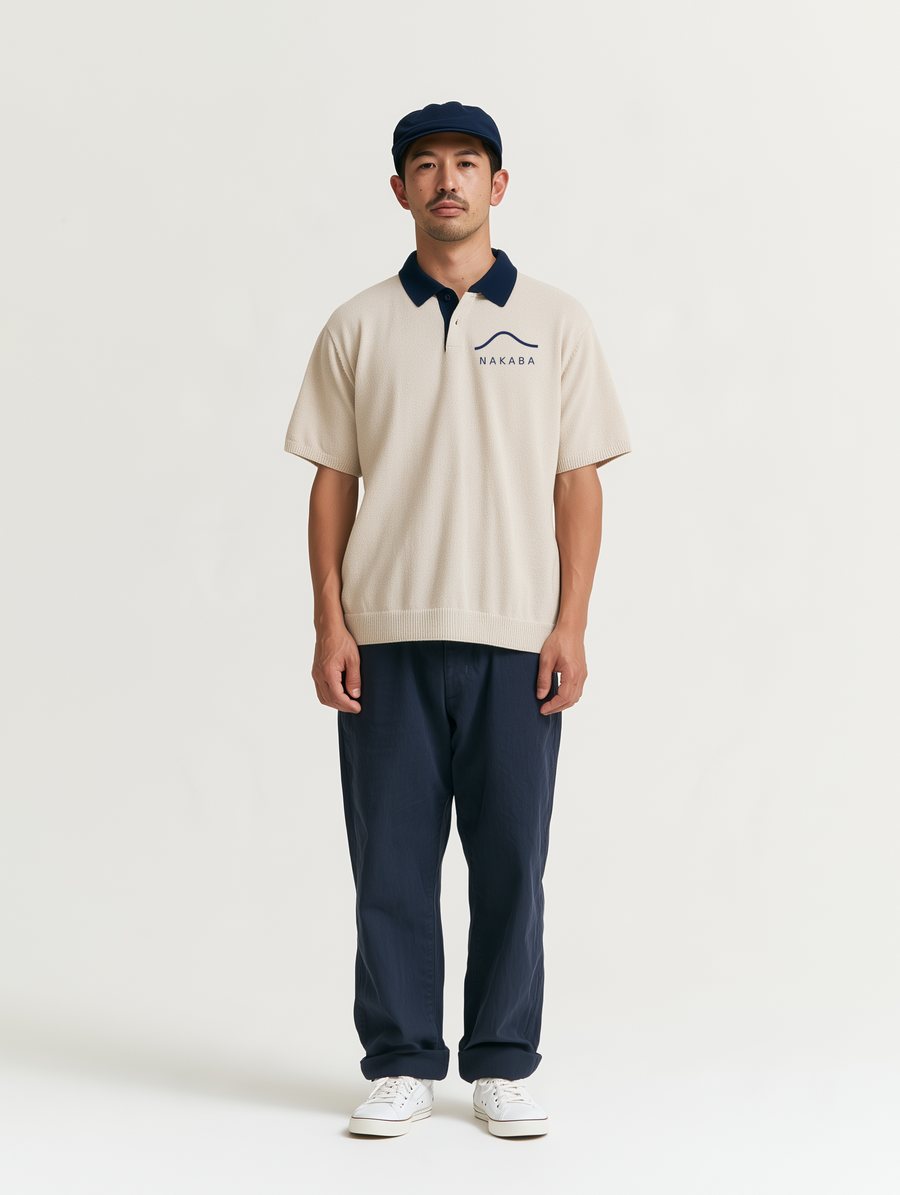
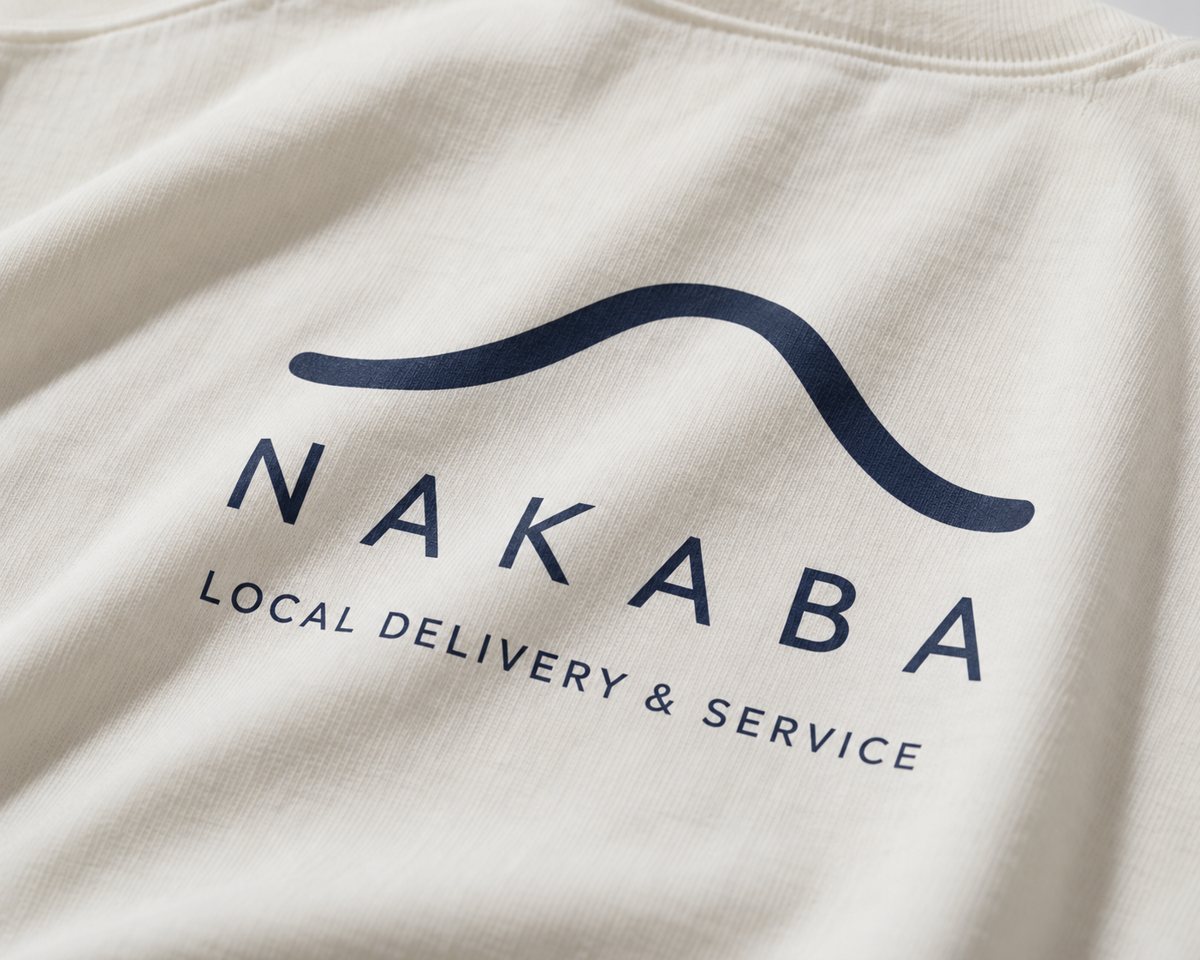
Logos and prints are part of the design, too.
A small company name on the chest, or a mark across the whole back. Embroidery or print, where and how large, even the typesetting of your name and tagline. No logo yet? We can start from the mark — or from reviewing the one you have.
What else we can make, beyond uniforms
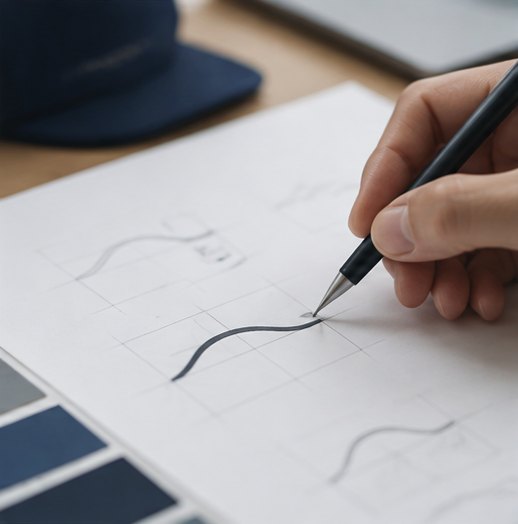 01Logos & marks
New designs and redesigns, with data ready for embroidery and print.
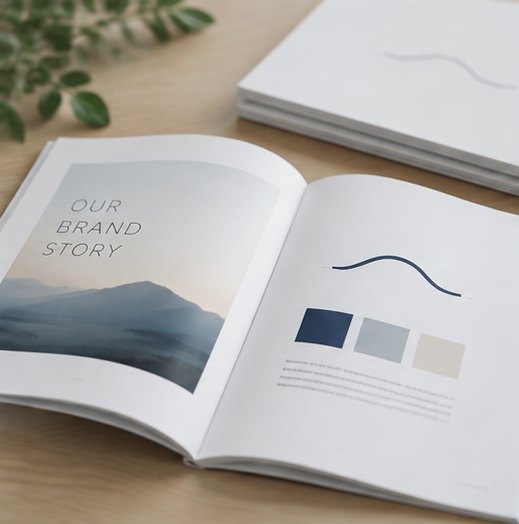 02Brand books & internal booklets
Why it's changing, how to wear it. Hand it out and use it to explain.
 03Photography
Photos of the new uniform for your recruitment site, job ads and company newsletter.
 04Web & report materials
The story and photos of the change, for recruitment pages and integrated reports.
OtherCaps, name badges, bags and other accessories, matched to the uniform's colors and marks. For anything else your branding needs, just ask.
How Project and Retainer differ
A Project runs from assessment through concept, design, operating rules and internal rollout. A Retainer adds external communication and impact measurement, and continues with annual renewals. We can measure impact in numbers because the records stay in the DPP and the portal.
- Assessment
Inventory and management interviews, with fitting sessions
- Concept
Put into words, then into form
- Design
Options, logo placement, fittings
- Operating rules
Issuing and renewal, joiners and leavers, take-back
- Internal rollout
Briefing materials and wearing guides
- External materials
Recruitment branding, integrated reports
- Impact measurement
Costs of issuing, repair and renewal — in numbers, from the records
See what each stage involves+
- Assessment
- Inventory and management interviews, with fitting sessions
- Concept
- Put into words, then into form
- Design
- Options, logo placement, fittings
- Operating rules
- Issuing and renewal, joiners and leavers, take-back
- Internal rollout
- Briefing materials and wearing guides
- External materials
- Recruitment branding, integrated reports
- Impact measurement
- Costs of issuing, repair and renewal — in numbers, from the records
* The chart shows the branding work only. Production runs in parallel once the design is fixed: from about 6 months with an existing fabric, and a year or more when developing a new fabric. Periods are guides. Impact figures come from the records kept in the DPP and the portal. CO₂ figures will follow as we measure them, and SSBJ-ready formats as we shape them to what the standards ask for.
Flow — how a consultation works
The first month — interviews and proposal
How we get to a quote.
This is the path from a made-to-order or branding inquiry to a quote. For ready-made, we can quote as soon as the style and quantity are set. What will we ask? What should you prepare? How long does it take? Below is our standard process; some requests add stages. All times are guides.
- 01Via the form. If you can share roles, rough quantities and timing, we can be specific from the first meeting.
- 02What you wear now and what isn't working. We'll also tell you up front what incurs costs.
- 03The tasks in each role, and realistic quantities and lead times. From here, we can give you figures.
- 04From existing fabrics, to suit function and use — with colors, size range and finishing.
- 05In a format for internal approval, with a breakdown and assumptions you can circulate as is.
Via the form. If you can share roles, rough quantities and timing, we can be specific from the first meeting.
What you wear now and what isn't working. We'll also tell you up front what incurs costs.
The tasks in each role, and realistic quantities and lead times. From here, we can give you figures.
From existing fabrics, to suit function and use — with colors, size range and finishing.
In a format for internal approval, with a breakdown and assumptions you can circulate as is.
Costs start here.
Visits, samples and prototypes are charged separately. We explain what incurs costs at the first meeting, and give amounts once your requirements and quantities are clear.
No fixed quantities or dates? We'll still give you a price and lead-time estimate.Free up to the quote (excluding visits, samples and prototypes).
Portal
From quote to delivery, on one screen.
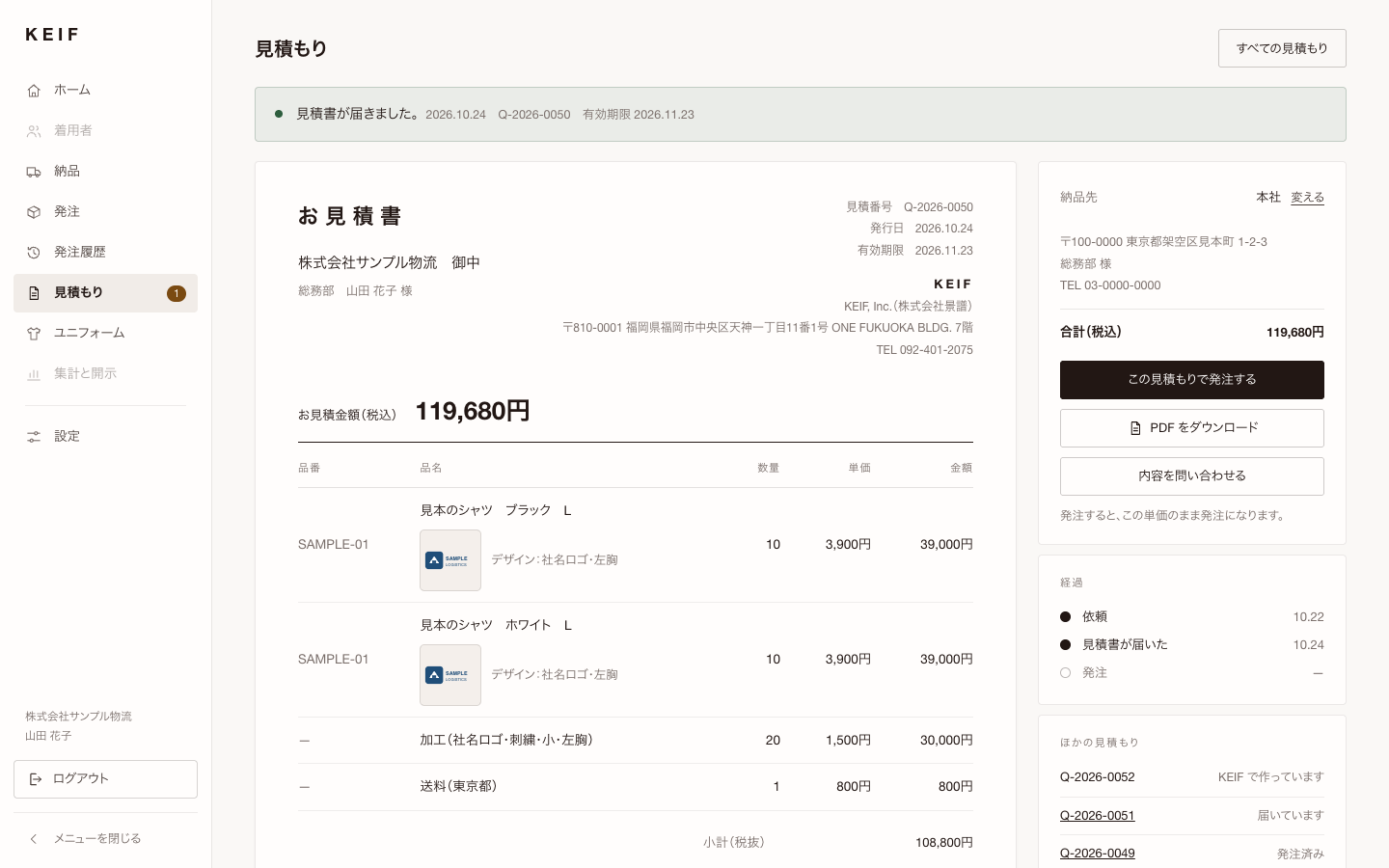
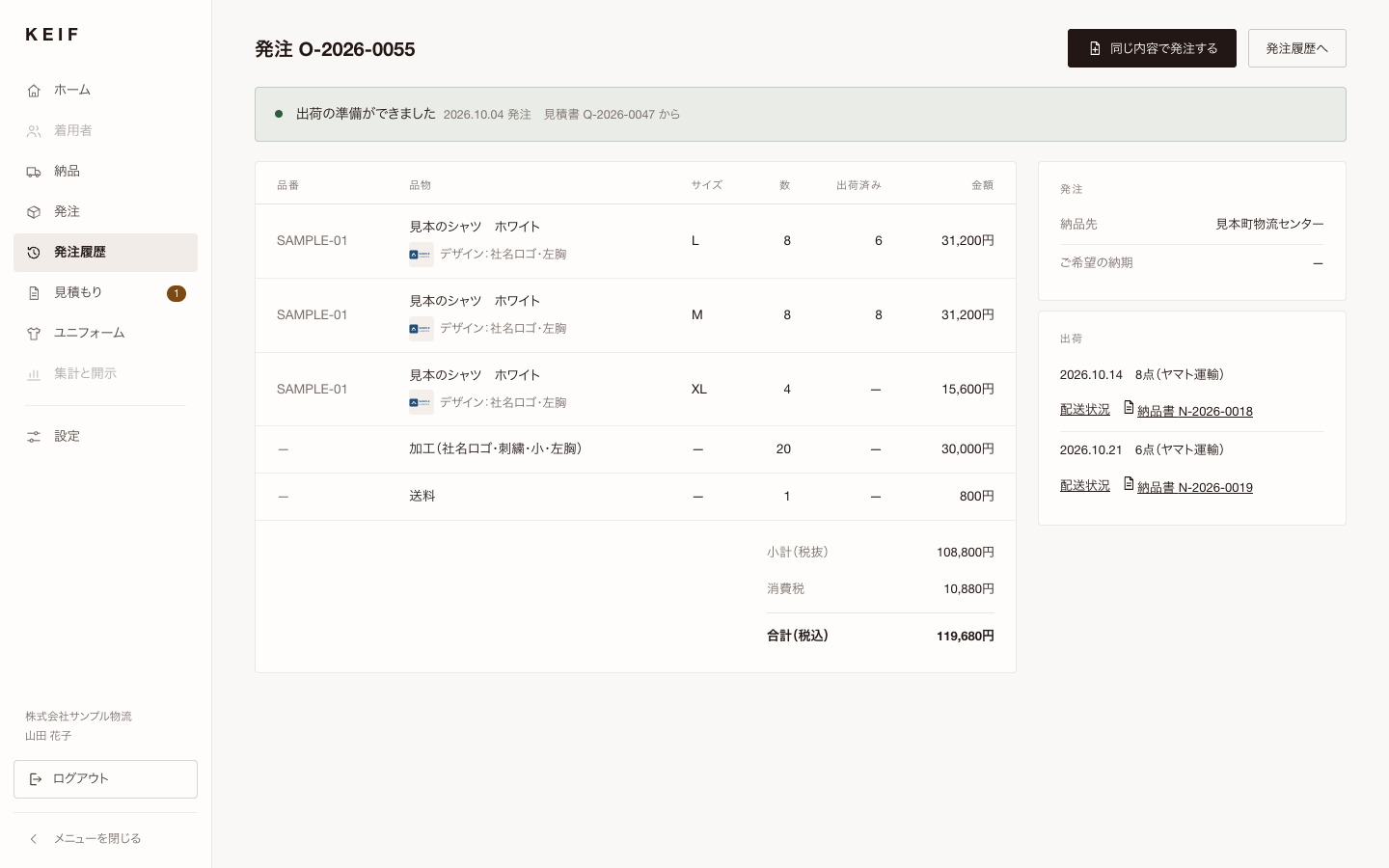
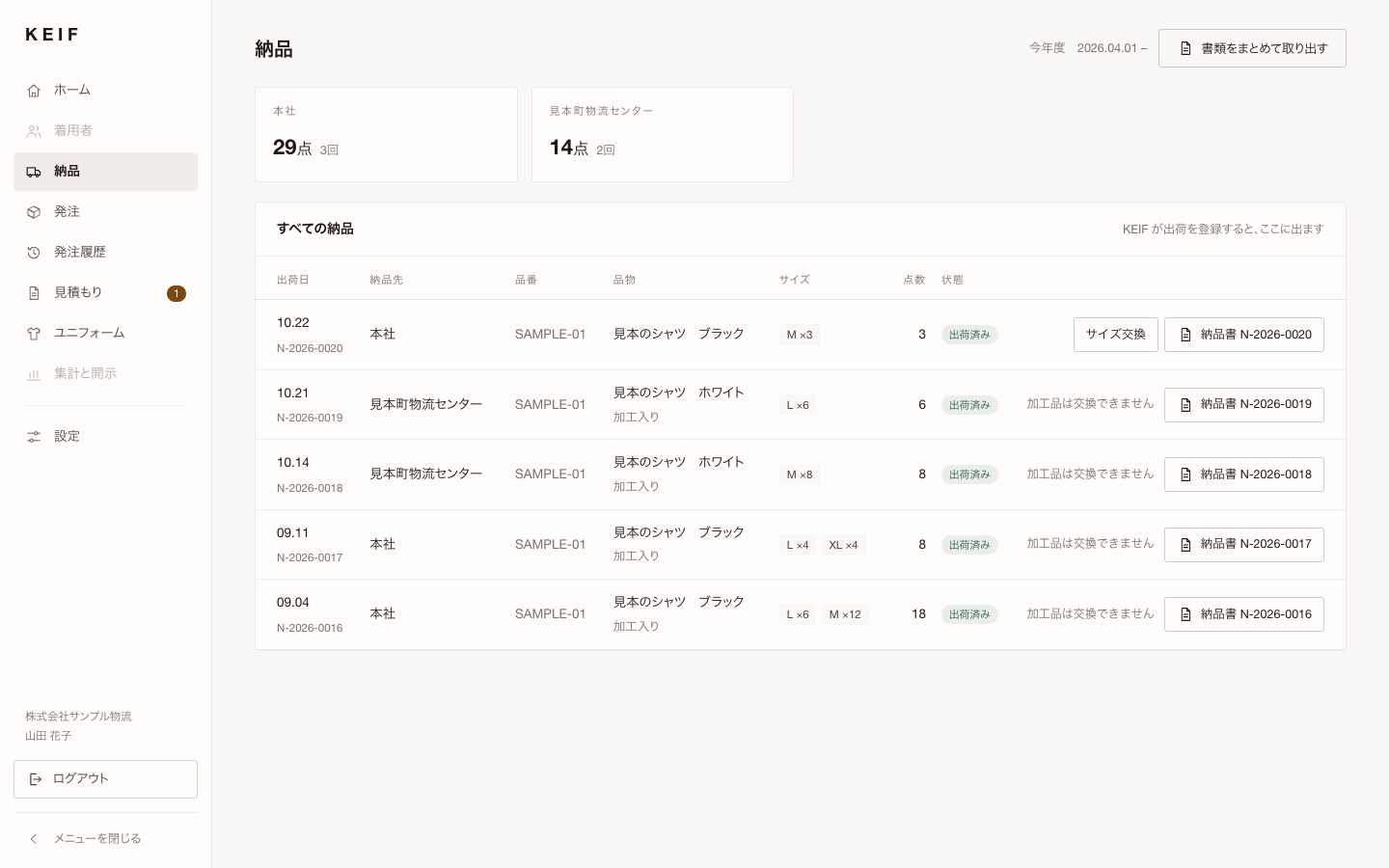
From receiving quotes to ordering, shipping, delivery notes and size exchanges — everything between you and KEIF on one screen. Quote-to-delivery features are free for existing clients. We will also add reports summarizing records for your purchases (some will be offered as paid services).
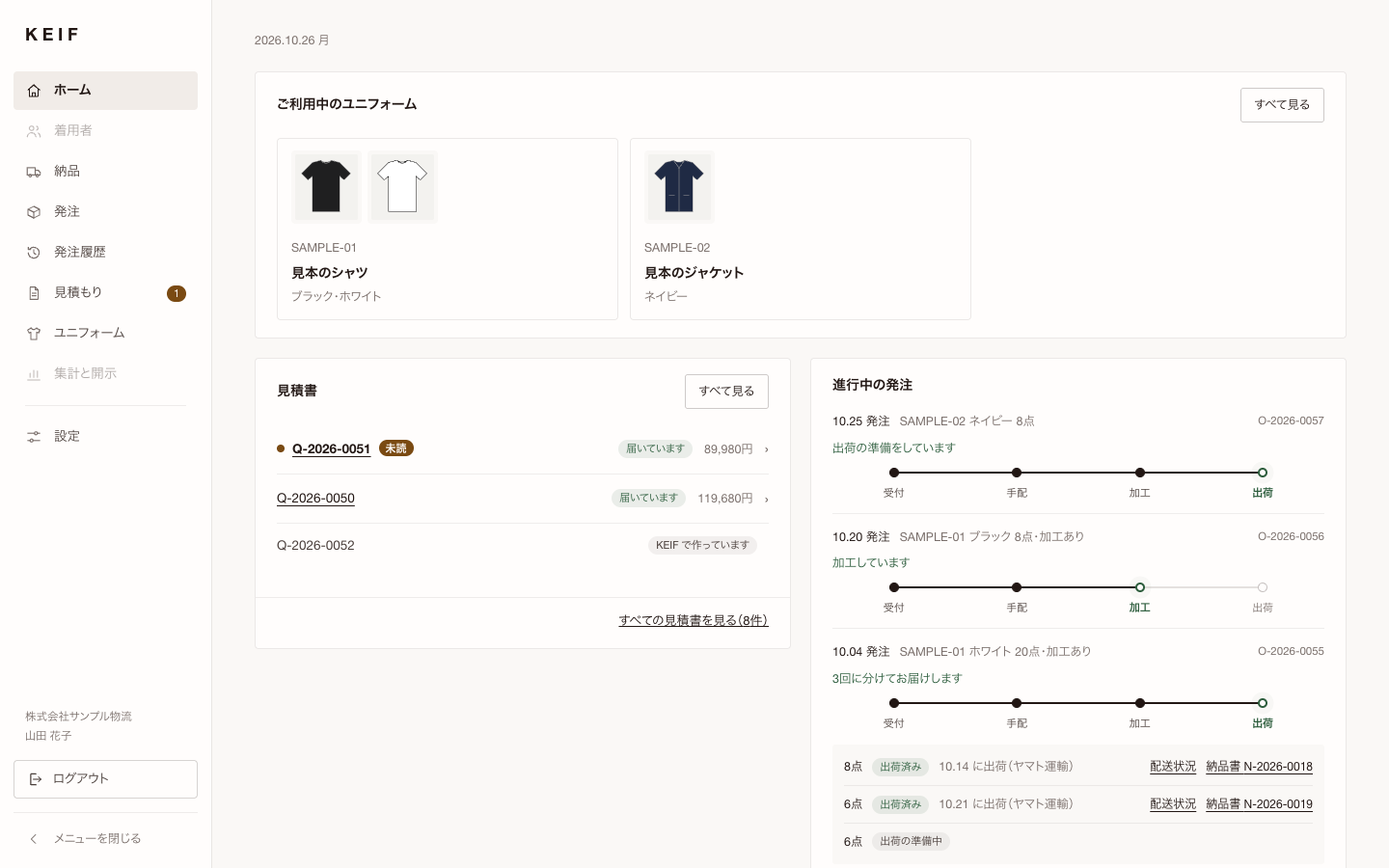
Your current uniforms, quotes received and the progress of open orders, all on the first screen.
Check quotes on screen and as PDFs, and order directly at the quoted prices.
For each order, see what has shipped, what remains and where deliveries are.
Delivery notes are always available. For unfinished items, request a size exchange on screen within 7 days of delivery.
The portal is available in Japanese.
All Services — for 01, 02 and 03
Records come standard, with every service.
Issued for every style, color and size: which yarn was woven where, where it was sewn, and how it was shipped. Use it for your Scope 3 Category 1 calculation basis, supplier questionnaires and SSBJ disclosures.
Contact
We'll help you decide where to start.
Uniforms only, branding only, the portal only — or a mix. Tell us where you are, and we'll suggest the combination that fits.