KEIF / Anatomy / Logistics & warehousing
This one garment holds
eight decisions.
Anatomy 01 — Logistics Blouson
A blouson designed for logistics and warehouse work. Moving between indoors and out, carrying loads, lifting them onto shelves, pushing trolleys — each movement has a shape that answers it. We've written down what we did, and why, for every part.
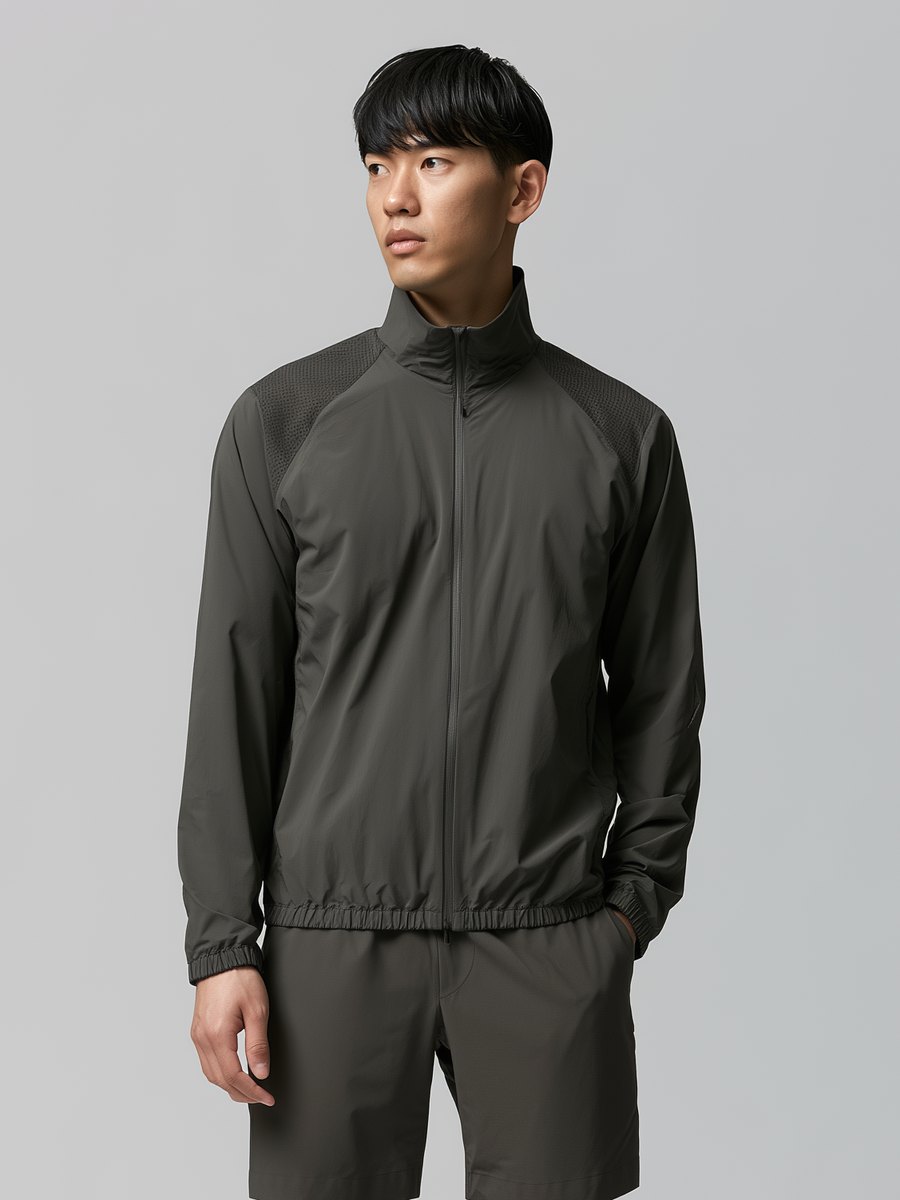
Stand collar
Carry a load and your chin meets the collar, so it stops at a height that doesn't touch the neck. Zip it up outdoors against the wind; open the front indoors to let heat out. There is no hood — it would catch on shelf corners and the edges of loads every time.
Stand collar
Carry a load and your chin meets the collar, so it stops at a height that doesn't touch the neck. Zip it up outdoors against the wind; open the front indoors to let heat out. There is no hood — it would catch on shelf corners and the edges of loads every time.
Front zip
When you push a trolley, the zip rubs against the load. Metal would leave marks, so we use a matte resin zip — which also isn't cold to the touch in winter. The pull is large enough to grab with gloves on.
Mesh shoulder panels
Heat builds up only across the shoulders and upper back, and that doesn't change however much you move. So only that area switches to mesh, in a dark shade of the same color. If the panel read as a pattern, it would look like sportswear, not a uniform.
Raglan sleeves
Raise your arms to put a load on a high shelf. With a seam on the shoulder, the body lifts with your arms and the hem rides up. So there is no seam on the shoulder.
Side panels
Carrying heavy loads puts the most strain under the arms. A separate panel joining front and back goes there, cut from its own pattern to give room.
Pocket openings
Gloves in and out, delivery slips in and out — dozens of times a day. Tears always start at the corners, so both ends are bar-tacked.
Hem elastic
Bend down and your back shows, so the hem is gathered. But a tight gather all the way round makes it hard to get on and off, so it is looser at the front and firmer at the back. The elastic is a separate component from the fabric; we aim to attach it so it can be cut away at take-back.
Cuff elastic
Sleeves shouldn't catch on loads or trolleys. The elastic holds a rolled-up sleeve in place: too tight and it restricts circulation, too loose and it slips down. The elastic is a separate component from the fabric; we aim to attach it so it can be cut away at take-back.
A grid weave stops a tear where it starts. A snag on a warehouse fitting or a cable tie won't spread into a hole. We aim to get stretch from the weave structure itself. It is designed so that, at end of life, you can choose how to recover it without separating fibers.
Design concept image. Dimensions and specifications are decided after we learn about your site.